
Unexpressed emotions can either diminish or build up within you. When their influence feels overwhelming, you may feel compelled to release them, as their suppression can be harmful. One way to do this is through sublimation, where emotions are channeled indirectly into constructive outlets.
The American Psychological Association defines sublimation as “a defense mechanism in which unacceptable sexual or aggressive drives are redirected into new, learned behaviors, which indirectly provide some satisfaction for the original drives… Such outlets are posited to protect individuals from the anxiety induced by the original drive.”
The term “sublimate” originates from the Latin word “sublimare,” which means “to lift” or “to raise.” In ancient times, it was used to describe the process of turning a solid substance directly into a gas, bypassing the liquid phase—a phenomenon known as sublimation.
The concept of sublimation originated in psychoanalytic theory, particularly within the framework developed by Sigmund Freud. In The Ego and the Id (1923), Freud introduced sublimation as part of his broader exploration of the structure of the mind and the mechanisms that govern human behavior.

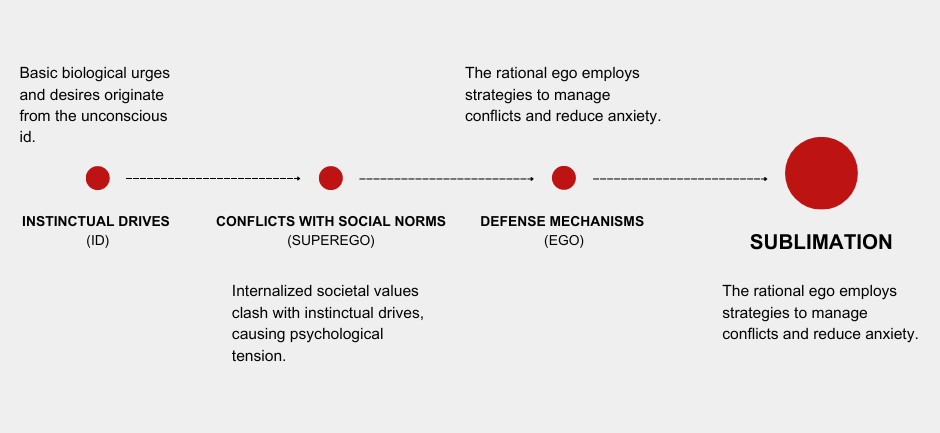
He proposed that people possess various unconscious drives, instincts, and desires, including impulses that are socially unacceptable or considered taboo. When such desires clash with social rules or moral standards, they are often repressed by the conscious mind to avoid inner conflict or anxiety. However, Freud observed that repression alone does not always resolve the tension created by these impulses. In some cases, instead of remaining buried, these repressed urges are redirected into forms of expression that are socially acceptable and even valued.
Freud initially described sublimation in relation to sexual and aggressive instincts, arguing that these primal drives could be transformed and channeled into culturally productive activities such as art, scientific inquiry, or altruistic work. He viewed sublimation as a crucial process for both individual development and the functioning of society, as it allows potentially destructive energies to be converted into constructive outcomes. Through this redirection, difficult or conflicted desires find expression without causing harm, supporting psychological balance and social cohesion.
From a psychological perspective, sublimation operates as a defense mechanism employed by the ego to manage the ongoing conflict between the id’s instinctual demands and the superego’s internalized moral standards. Rather than expressing unacceptable impulses directly or suppressing them entirely, the ego transforms their energy into activities that align with social norms. In this way, the ego plays a central mediating role, maintaining equilibrium by satisfying instinctual needs in altered, socially approved forms.
This process involves the transformation of instinctual energy itself, particularly sexual and aggressive drives, into creative, productive, or altruistic pursuits. Instead of acting on these impulses in ways that could be harmful or disruptive, individuals channel them into outlets that contribute positively to both personal and collective life. The specific forms sublimation takes are shaped by cultural norms and values, which determine what is considered acceptable or meaningful within a given society and historical context.
Over time, sublimation also supports personal development by fostering adaptive coping strategies and helping individuals integrate conflicting desires into a coherent sense of self. By directing inner tension toward purposeful goals and self-actualizing activities, sublimation can lead to a sense of fulfillment and achievement, reinforcing both psychological resilience and social participation.
Sublimation in Art
Among all these forms, art offers one of the most nuanced and psychologically rich spaces for sublimation, as it allows inner experience to be translated directly into symbolic form. In the artistic process, conflicts, emotions, and impulses are not merely redirected but transformed into visual, tactile, or symbolic representations of the subconscious. Through painting, drawing, sculpting, or collage, overwhelming or distressing feelings can be reshaped into metaphorical expressions that make inner tension visible and meaningful. Artistic creation enables the externalization of inner experience, allowing individuals to explore subconscious thoughts, unresolved conflicts, and complex emotions in a safe, nonverbal way.
Artwork often functions as a symbolic mirror of the inner world, using imagery, metaphor, and visual language to convey psychological depth and personal narratives that may be difficult to articulate directly. This symbolic dimension gives art its therapeutic potential, promoting emotional regulation, self-awareness, and psychological growth. In structured settings such as art therapy, sublimation becomes a conscious tool for healing, offering a supportive and nonjudgmental space to process deeply held emotions. Beyond the individual, artistic sublimation also carries cultural and social significance. Art can act as a form of collective sublimation, expressing shared anxieties, desires, and hopes, and fostering empathy and understanding through universal themes that resonate across personal and cultural boundaries.

Whatever the outlet, sublimation is a powerful psychological mechanism that transforms instinctual energy into socially constructive and meaningful expression. In everyday life, it redirects primal drives toward productive goals that support personal development and social harmony. In art, this process goes further by turning inner conflict into insight, emotion into form, and tension into meaning. Through sublimation, instinct is not denied but elevated, offering purpose, fulfillment, and connection through creativity and cultural contribution.
 Artenquire