
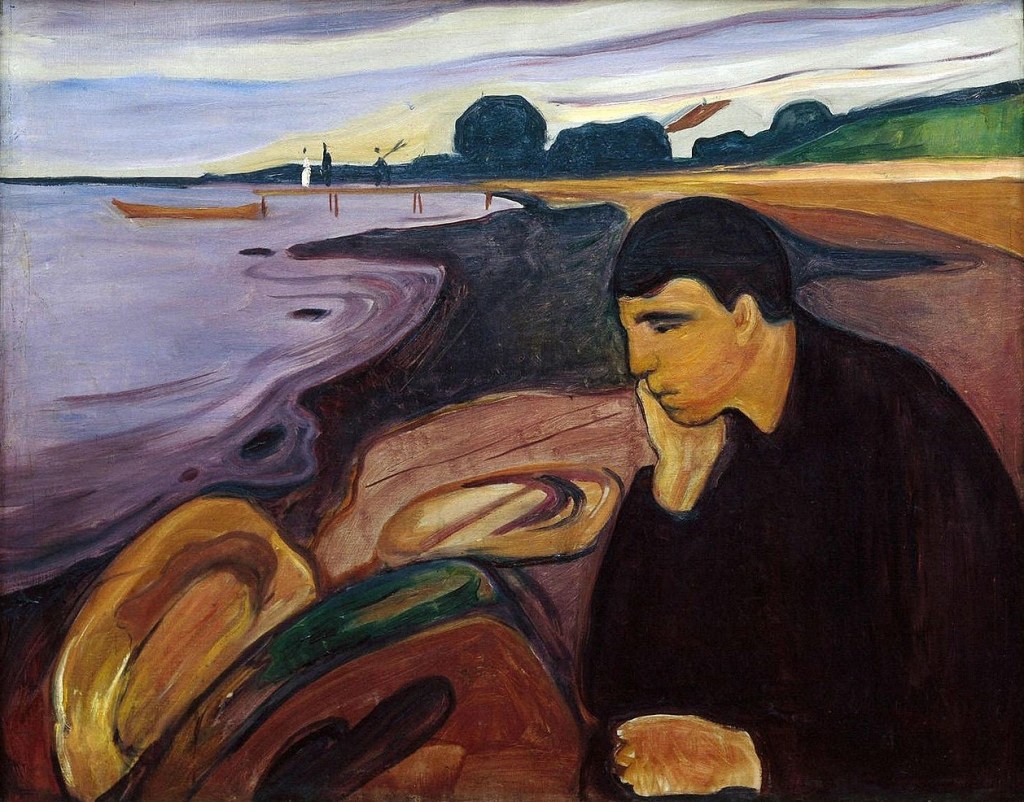
Edvard Munch, synonymous with raw emotion and deep introspection, has left an unerasable mark on art. His works speak to the heart of being human. They reflect his struggles and the broader philosophical questions that have puzzled humanity for centuries.

Edvard Munch went through intense personal struggles that deeply influenced his art. His battles with mental health, shaped by a childhood marred by tragedy and loss, became a wellspring of inspiration for his work. These struggles, while a source of profound pain, also fueled his creative genius. They encouraged him to produce emotionally powerful and psychologically complex art.
Edvard Munch was born on December 12, 1863, in Løten, Norway, into a family marked by hardship and illness. His father, Christian Munch, was a stern military doctor with deep religious convictions, which instilled in Edvard a sense of strict morality and a preoccupation with death and the afterlife. Munch’s mother, Laura Cathrine, died of tuberculosis when Edvard was just five years old. This loss had a profound impact on him, introducing him to the harsh realities of life and death at a very young age.
The family was further struck by tragedy when Munch’s older sister, Sophie, also died from tuberculosis at the age of 15. These early experiences with illness and death deeply affected Munch, and the themes of sickness, death, and mourning became recurrent motifs in his work. Growing up in an environment of constant fear and grief, Munch often expressed in his art the anxiety and sorrow that he internalized during these formative years.
Munch’s personal life was a tumultuous one, fraught with mental health struggles that influenced much of his artistic output. He experienced frequent bouts of depression and anxiety, conditions that were worsened by his family’s history of mental illness. His father’s rigid and oppressive religious views, combined with the constant presence of death, contributed to a sense of existential dread that permeated his life and work.
Munch’s mental health issues became more pronounced as he grew older. In the early 1900s, he suffered a severe nervous breakdown, which led him to seek treatment at a sanatorium. During his stay, Munch underwent various forms of therapy, including electroconvulsive treatment. This period of intense psychological distress was pivotal, as it not only provided temporary relief but also influenced his subsequent works, which became more introspective and focused on the inner workings of the mind.
Munch’s struggles with mental health were not just personal but also artistic. His works often reflected his emotional state, with themes of fear, anxiety, and existential despair being prominent.
Anxiety in Munch’s Paintings
Edvard Munch’s portrayal of anxiety in his works gives us a raw, honest look into the human psyche. The Scream, Anxiety, and The Sick Child are not just paintings; they’re emotional outpourings that show us Munch’s deepest fears and sorrows. These pieces connect with us on a personal level, reminding us of our moments of dread and loss.
The Scream (1893-1910)
The Scream is undoubtedly Edvard Munch’s most famous work and a quintessential symbol of modern existential angst. Munch created multiple versions of this iconic piece between 1893 and 1910. He described the inspiration for The Scream in his diary, recounting a walk with friends at sunset when he suddenly felt a profound melancholy and an overwhelming, infinite scream passing through nature. This experience, deeply personal and emotionally intense, became the foundation of the painting.
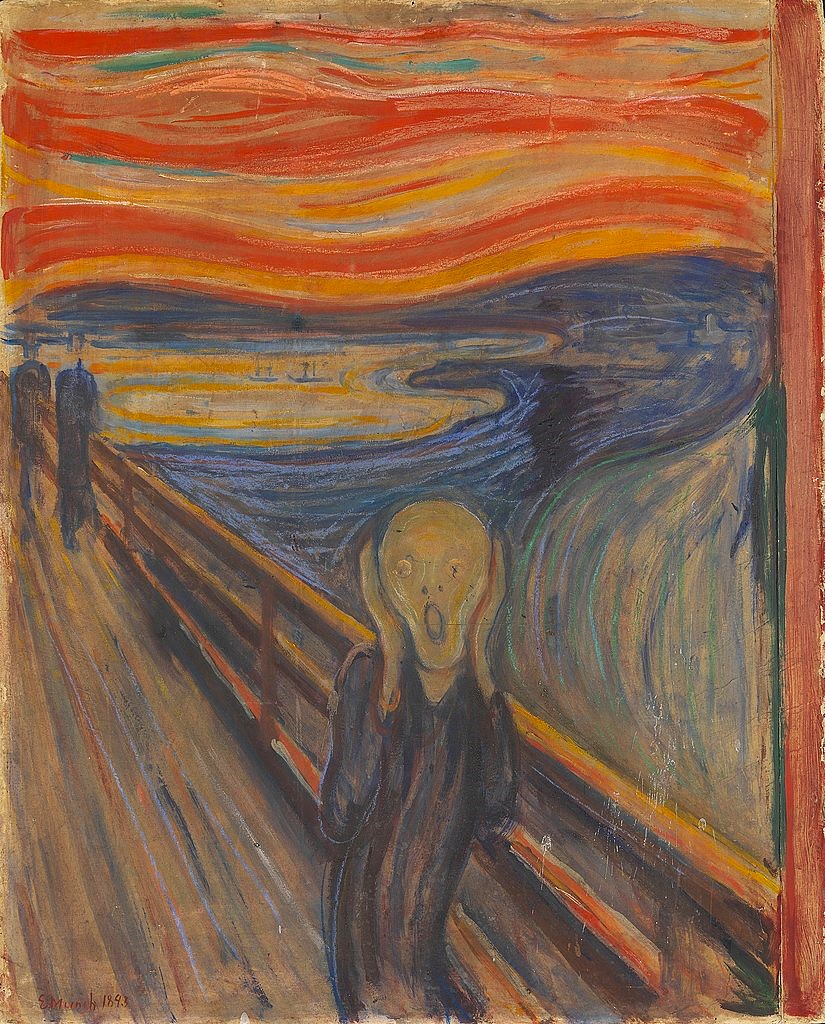
Munch’s use of vivid, almost violent colors and swirling lines creates a sense of chaos and emotional turbulence. The sky, painted in dramatic hues of red and orange, seems to be ablaze, reflecting the inner turmoil of the figure in the foreground. The curving lines of the landscape and the bridge add to the sense of disorientation and instability. The figure itself, with its androgynous, skeletal appearance, is rendered in simple yet powerful strokes, emphasizing the raw, primal nature of its scream.
The figure’s open-mouthed scream and wide eyes are universally recognizable symbols of existential dread and anxiety. The painting captures the essence of a moment of intense psychological crisis, resonating with anyone who has experienced profound fear or despair. The contrast between the figure’s intense emotion and the serene, detached figures in the background highlights the isolating nature of anxiety, emphasizing the feeling of being alone in one’s distress.
Anxiety (1894)
This work depicts a crowd of ghostly figures walking along a pier, their faces contorted in expressions of dread and unease. This work can be seen as a companion piece to “The Scream,” further exploring the theme of collective existential anxiety.
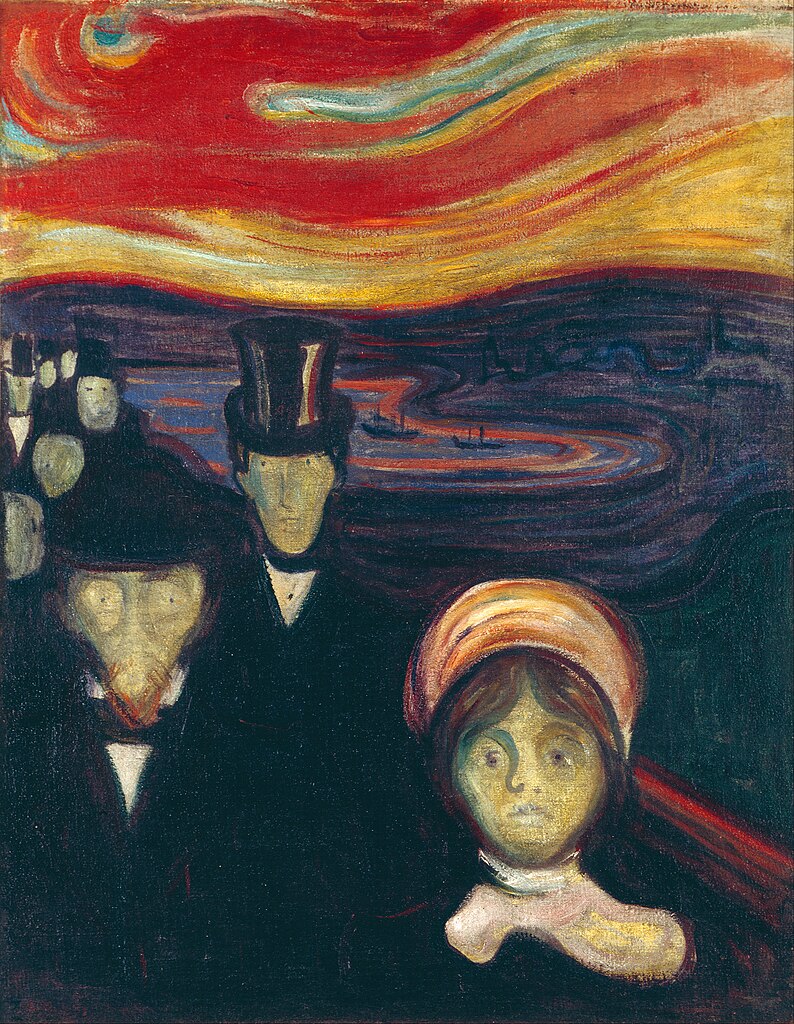
The composition of Anxiety is dominated by the figures’ haunting, mask-like faces, which seem to float against the backdrop of a tumultuous sky. The use of dark, oppressive colors creates a claustrophobic atmosphere, mirroring the internal anxiety of the subjects. The distorted perspectives and exaggerated features enhance the feeling of disorientation and emotional turmoil.
The painting reflects Munch’s belief in the universality of anxiety, suggesting that it is a shared human experience rather than an individual affliction. The repeated, almost monotonous expressions of the figures evoke a sense of inevitability and helplessness, highlighting the pervasive and inescapable nature of existential dread.
The Sick Child (1885-1886)
This painting is a deeply personal work for Munch, rooted in his childhood trauma of losing his mother and sister to tuberculosis. The painting depicts a young girl lying in bed, frail, with an adult figure, presumably her mother, seated beside her in a state of sorrowful contemplation.
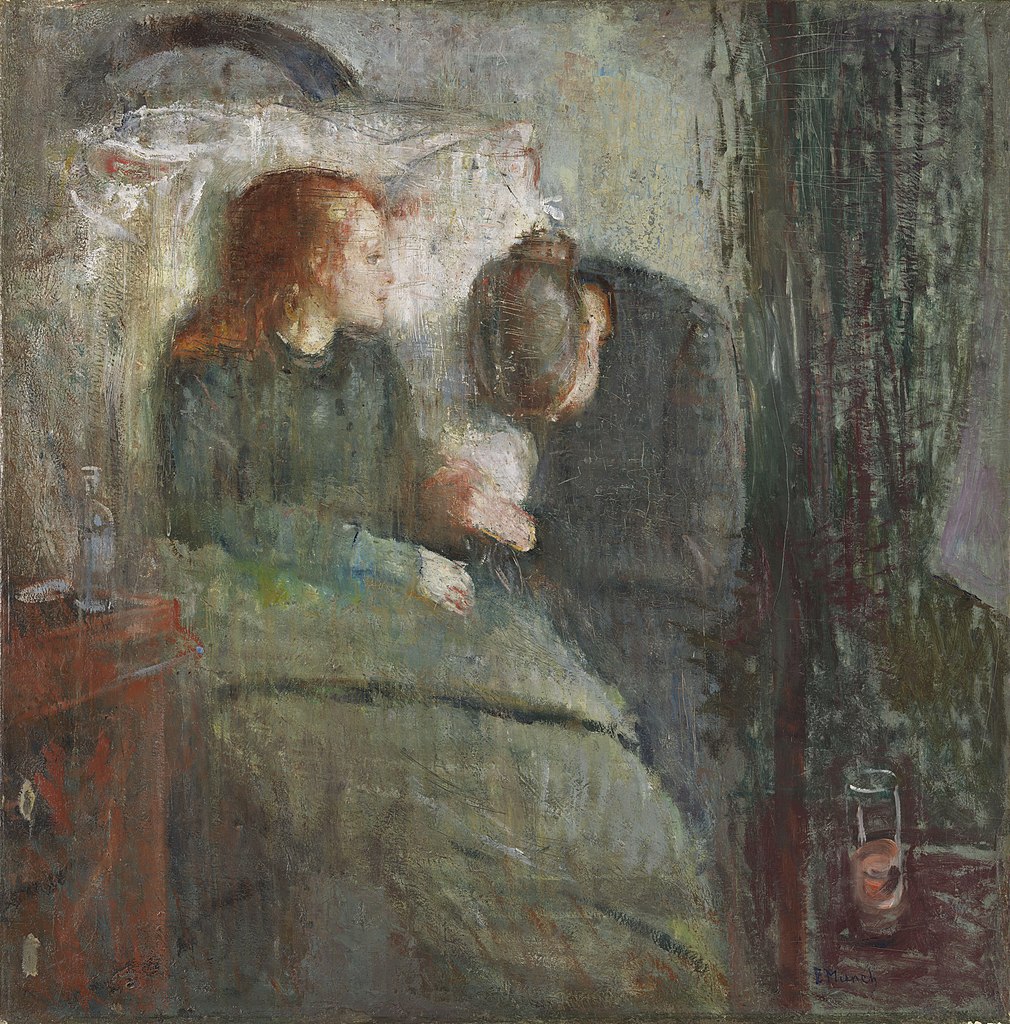
The somber tones and subdued palette of The Sick Child reflect the quiet, pervasive grief of the D scene. The loose, sketch-like brushstrokes give the painting an ephemeral quality, mirroring the fragility of life and the fleeting nature of health. The adult figure’s bowed head and clasped hands convey a deep sense of mourning and helplessness, underscoring the emotional impact of illness and loss.
This painting captures the profound sorrow and anxiety associated with the loss of a loved one, a theme that recurs throughout Munch’s work. It serves as a poignant reminder of the personal pain that shaped Munch’s artistic vision, and its emotional intensity resonates with viewers, evoking empathy and reflection on the universal experiences of illness and mortality.
Existential Themes in Munch’s Art
Edvard Munch’s art is deeply intertwined with existentialist philosophy, a movement that focuses on individual existence, freedom, and choice. Among the existentialist philosophers, Søren Kierkegaard, a fellow Scandinavian, significantly influenced Munch’s work. Kierkegaard’s writings delve into themes of anxiety, despair, and the individual’s confrontation with the absurdity of life. His concept of “the sickness unto death,” which deals with the idea of despair as a condition of the self, resonates strongly with the emotional depth found in Munch’s art.
Munch’s paintings often explore existential dread, isolation, and the search for meaning. His works are a visual representation of the existential struggle, capturing the profound sense of anxiety and alienation that comes with the human condition. The artist’s frequent use of dark, swirling colors and distorted figures reflects the inner turmoil and existential angst that are central to existentialist thought.
Death in the Sickroom (1893)
Death in the Sickroom depicts a gloomy scene of family members gathered around a sickbed, each lost in their own world of grief and reflection. The composition is marked by its subdued colors and quiet, introspective mood. Unlike traditional depictions of deathbed scenes, Munch’s work focuses not on the dying individual but on the emotional responses of those left behind.
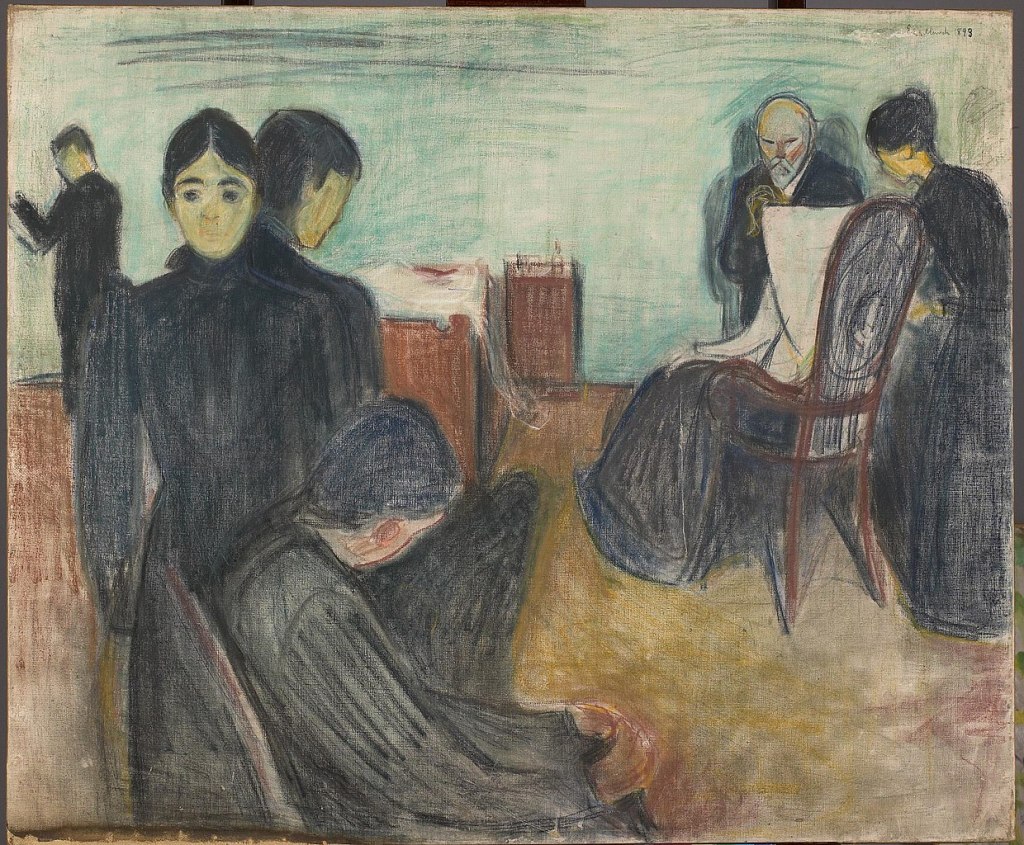
The painting powerfully conveys themes of isolation and mortality. Each figure is absorbed in their thoughts, physically close yet emotionally distant from one another. This separation underscores the existential theme of isolation, emphasizing the idea that, ultimately, each person faces death alone. The muted palette and stark composition heighten the sense of stillness and introspection, inviting viewers to contemplate their mortality and the solitude accompanying it.
The Dance of Life (1899-1900)
The Dance of Life captures the cyclical nature of existence through a dance motif. The painting features couples dancing under the moonlight, with figures representing different stages of life. On the left, a young woman in white symbolizes innocence and youth; in the center, a couple in a passionate embrace embodies the peak of life and love; and on the right, an older woman in black signifies the inevitability of aging and death.
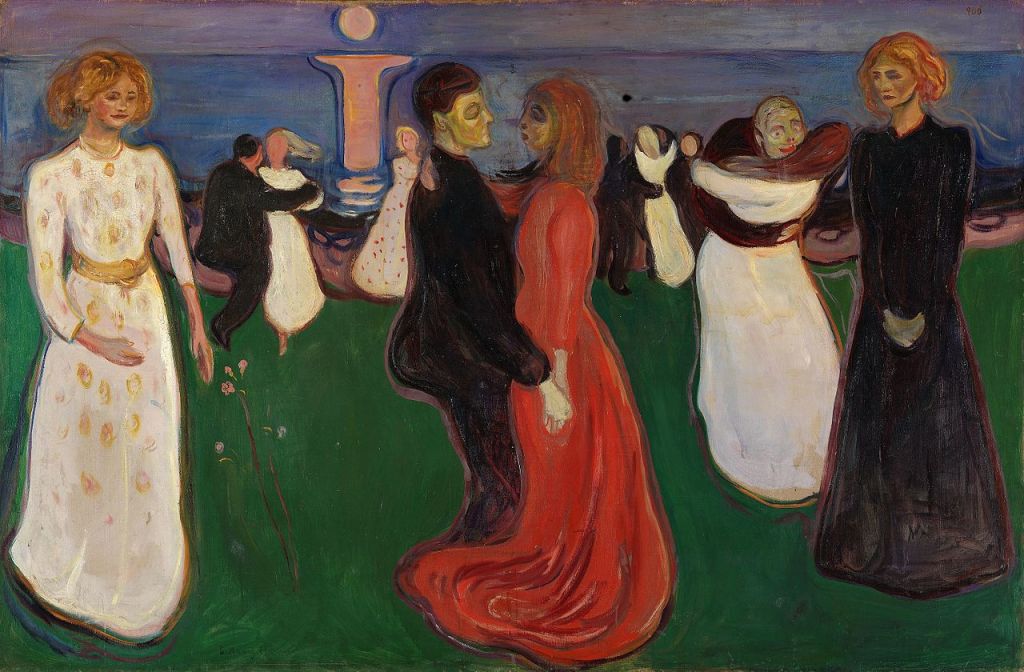
This painting reflects existential themes by portraying life as a continuous dance, marked by the passage of time and the inevitability of change. The central couple, immersed in their dance, seems oblivious to the figures on either side, symbolizing how individuals often become absorbed in the present moment, unaware of the fleeting nature of time. The somber expressions of the older woman and the setting sun in the background evoke a sense of melancholy, reminding viewers of the transient nature of life and the existential quest for meaning amidst the inevitability of aging and death.
Edvard Munch’s Expressionism
Edvard Munch is closely linked to Expressionism, a movement that developed in the early 20th century and focused on showing emotions rather than physical reality. Expressionist artists were less interested in accuracy and more concerned with how feelings like fear, anxiety, and sadness could be visually expressed. Munch’s work fits this approach well, as he used painting as a way to explore his own emotional and psychological experiences.
Instead of realistic figures, Munch often distorted the human body to reflect inner states. His characters appear twisted or stretched, as if shaped by their emotions. Color plays a strong role too: he used intense, unnatural tones to heighten the mood. In The Scream, the blood-red sky and dark landscape intensify the feeling of panic, while in The Sick Child, dull greens and deep shadows create a quiet, heavy sadness. Munch also used dynamic compositions, such as off-center figures, sharp angles, and swirling lines, to create tension and movement. These choices pull the viewer uncomfortably close to the subject, mirroring the sense of anxiety and emotional pressure present in his work.
Edvard Munch’s innovative techniques and thematic focus profoundly influenced modern art. His investigation of psychological and emotional depth paved the way for German Expressionism and Abstract Expressionism. Ernst Ludwig Kirchner and Emil Nolde drew inspiration from Munch’s bold use of color and emotional intensity. Later, the Abstract Expressionists, including Jackson Pollock and Mark Rothko, echoed Munch’s focus on the inner experience and psychological depth.
Munch’s research on personal trauma and existential themes also influenced the broader trajectory of 20th-century art, encouraging artists to explore their psyches and confront the human condition head-on.
 Artenquire