Hermann Rorschach’s inkblot test has long intrigued both psychologists and artists. Developed in the 20th century, it was a powerful way to explore how the human mind interacts with visual stimuli. Rorschach’s inkblots, deliberately symmetrical yet imperfect, do more than test perception—they offer a glimpse into the relationship between art and psychoanalysis. In this article, we are going to investigate this mysterious connection and find the logical bond between the Rorschach test and abstract art.
A Brief History of the Rorschach Test
Hermann Rorschach, a Swiss psychiatrist born in 1884, was deeply influenced by his combined interests in art and psychoanalysis. In 1921, he published Psychodiagnostik, the foundational text introducing his inkblot method. Here’s what he mentioned in the preface to this paper.
“The questions which gave rise to the original experiments of this sort (1911) were of a different type from those which slowly developed as the work progressed. The conclusions drawn, therefore, are to be regarded more as observations than as theoretical deductions. The theoretical foundation for the experiment is, for the most part, still quite incomplete.”
The Rorschach Test gained significant prominence in the United States during and after World War II, particularly in assessing military personnel and veterans. Notably, U.S. armed forces utilized the test to screen trainee pilots and soldiers to identify suitable candidates for service.
Today, the test is still used in clinical, forensic, and research settings, though its usage has declined compared to its peak. It is generally considered one tool among many, rather than a standalone diagnostic measure.
Personal Roots of the Rorschach Test
As a child, he was so engrossed in creating inkblot images that his friends nicknamed him “Klecks” which means “inkblot” in German. This early engagement with inkblots laid the foundation for his later work.
Rorschach’s fascination with inkblots was not a mere academic pursuit but deeply personal. Klecksography, a childhood game involving inkblot creations, paved the way to creating the outstanding personality test. Studying the inkblots, Rorschach theorized that the way individuals interpret ambiguous shapes could reveal underlying aspects of their personality and mental state. His method quickly gained attention in psychiatry and psychology, becoming a cornerstone of projective testing.
How Does the Rorschach Test Work?
Born from an artist’s hands as much as from a psychologist’s mind, the Rorschach test carries within it a paradox—an image with no intent, yet endless meaning. It demands engagement, drawing the viewer into a dialogue between abstraction and recognition. One person sees wings lifting toward the sky, another a gaping mouth, and yet another, a memory they cannot name. The test does not ask what the images are; it asks who the viewer is. Let’s dive deeper into the test itself.
The Ten Cards
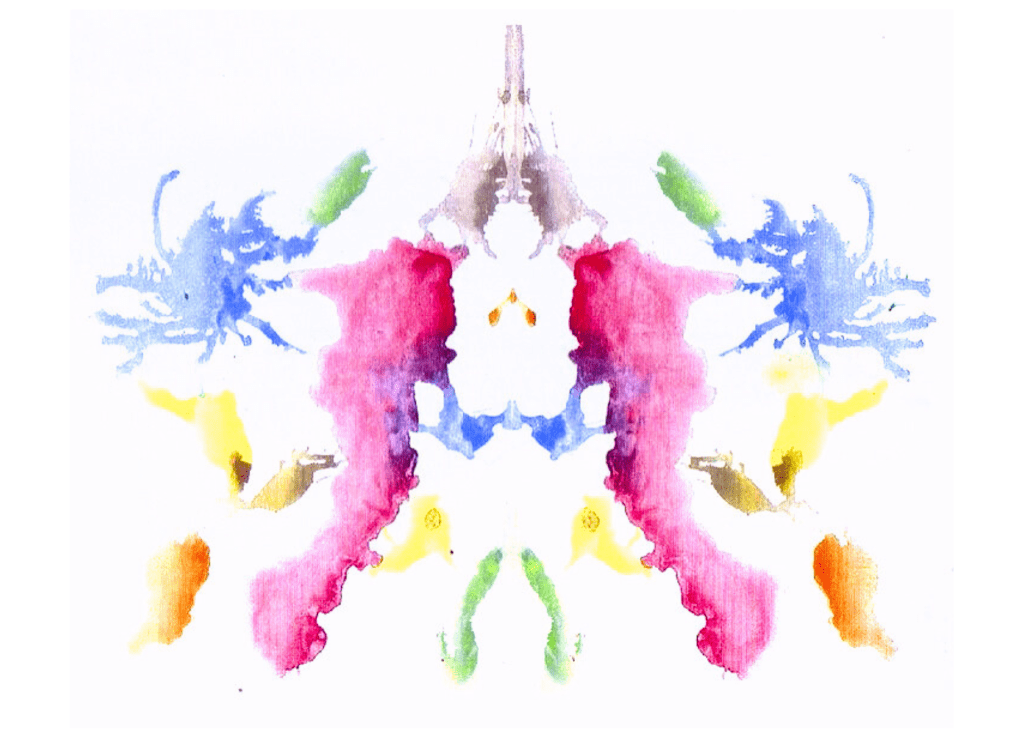
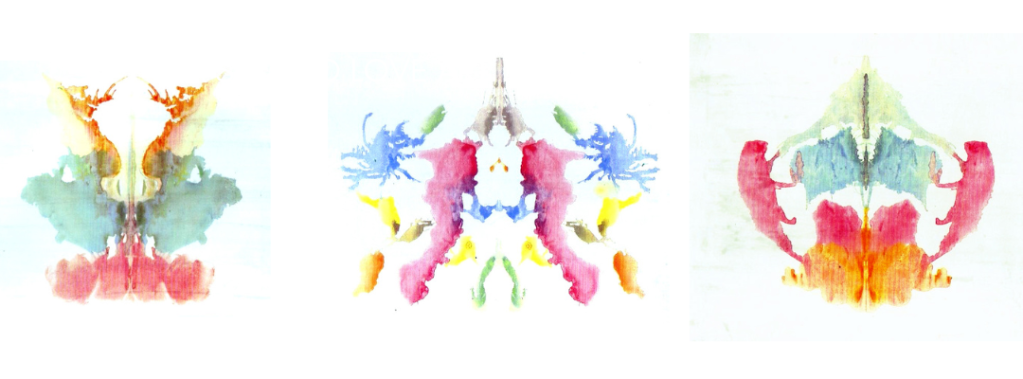
The test comprises ten cards, each featuring a unique inkblot. These cards are presented to the subject in a specific sequence, alternating between black-and-white and color images. The subject is asked to describe what each inkblot resembles or reminds them of, with responses recorded verbatim. This open-ended approach allows for different interpretations, reflecting the subject’s thought processes and emotions.
Scoring and Interpretation
Rorschach test responses are analyzed based on several criteria:
- Location: Which part of the inkblot the response pertains to.
- Determinants: The aspects of the inkblot that influenced the response, such as form, color, or shading.
- Content: The nature of the object or scene identified.
- Originality: The uniqueness of the response compared to common interpretations.
Where Is It Applied?
The Rorschach test is employed in clinical psychology, psychiatry, and forensic evaluations. It aids in diagnosing mental health disorders, understanding personality dynamics, and assessing emotional functioning.
The Rorschach Test and Abstract Art
Both abstract art and psychological assessments like the Rorschach Test invite subjective interpretations. It allows viewers or test-takers to project their unconscious thoughts, feelings, and experiences onto ambiguous stimuli. This projection process reveals deeper layers of the psyche, offering insight into personal conflicts, desires, and emotional states. Additionally, abstract art, like projective tests, is a form of self-expression. It provides a visual language for emotions that are difficult to articulate verbally.
“Almost from its origins, psychoanalytic theory has been applied outside the clinical sphere to works of art and used as a mode of understanding in at least three areas of major concern to aestheticians: namely, (1) the nature of the creative work and experience of the artist, (2) the interpretation of works of art, and (3) the nature of the aesthetic encounter with works of art.” – John E. Gedo, Art and Psyche: The Rorschach and the Use of Art in Psychological Assessment”
In the Rorschach test, each inkblot echoes abstract art by avoiding definitive interpretations, instead creating space for the viewer’s mind to shape meaning. The blots are intentionally designed to allow for fluid interpretations, allowing the viewers to project their thoughts and emotions onto ambiguous forms.
As the patient describes the blot, they become part of the process, projecting their own experiences and subconscious thoughts onto a blank canvas. Through this exchange, psychology and art intersect, not as opposites, but as reflections of a shared human impulse: to find coherence in chaos, to impose structure on the formless, and to recognize something familiar within the unfamiliar. The Rorschach test allows us to explore these dualities—both a psychological tool and an exercise in abstract interpretation.
“The psychology of the unconscious and abstract art, two groundbreaking ideas of the early twentieth century, were actually close cousins…” Damion Searls, The Inkblots: Hermann Rorschach, His Iconic Test, and The Power of Seeing
Abstract art and psychological assessments such as the Rorschach Test function as portals into the unconscious. They offer a space where individuals can project their innermost thoughts and emotions onto forms that are not immediately understood. Both the Rorschach test and abstract art embrace uncertainty, which lets the viewer’s own experiences and mind shape the meaning rather than giving a clear answer.
As John E. Gedo and Damion Searls suggest, the unconscious and abstract art reflect a profound human desire to make sense of chaos. It reveals the intricate relationship between creativity and psychological insight. Through these mediums, the complex interplay of structure and formlessness mirrors the dynamic of human experience, where we constantly search for meaning in the undefined.
Do People Buy the Rorschach Test as Artwork?
Yes, some people do buy Rorschach-like inkblot images as artwork. Their abstract and ambiguous nature appeals to those who appreciate art that invites multiple interpretations. The connection to the Rorschach test, with its roots in psychology and the human mind, can add depth to the artwork, making it even more intriguing.
Artists create variations of the Rorschach test, sometimes blending it with other forms of abstraction or surrealism. They use the inkblot technique to explore themes like perception, identity, and mental health, further linking these artworks to deeper psychological concepts. The visual impact of these pieces, combined with the psychological underpinnings they represent, makes them highly desirable for collectors or those seeking art with personal significance.
These artworks can be found in galleries, art auctions, and online art marketplaces. The growing interest in art that blurs the lines between science and creativity has contributed to the continued appeal of Rorschach-inspired works in the art world.
 Artenquire