
So, why is Impressionism called Impressionism? To put it briefly, because Claude Monet titled a painting Impression, Sunrise, and because a critic used that title to mock a movement that dared to be different. But more deeply, it’s because these painters wanted to portray the impression of a moment, rather than a polished illusion of permanence.
They painted what they saw, felt, and experienced—momentary flashes of reality filtered through a human lens. And in doing so, they gave the world a new way of seeing: raw, beautiful, imperfect, and alive. The name stuck not because it described their style, but because it captured their essence.
But let’s dive deeper into the background and fish for more interesting details.
Impressionism’s Historical Context: Paris in the 19th Century
To understand the origin of the term Impressionism, we must first look at the setting: Paris in the 1860s and 1870s, a time of great transformation. The Second Empire under Napoleon III was reshaping the city, modernizing streets, and expanding the middle class. Industrialization, urbanization, and advances in science were rapidly changing how people lived and saw the world.
Read more: Paris Art | The Role of Paris in Art History
In the heart of Paris art life, traditional art institutions like the Académie des Beaux-Arts and the Salon de Paris maintained tight control over what constituted “acceptable” art. Their preferences leaned toward idealized historical, mythological, or religious themes, painted with polished realism and strict academic technique. Artists who didn’t conform to these conventions often found themselves rejected or ridiculed.
But outside this rigid system, a group of young painters—Claude Monet, Pierre-Auguste Renoir, Camille Pissarro, Edgar Degas, Berthe Morisot, and others—were forging a new path. They wanted to capture modern life, fleeting light, and the sensory experience of the world. Their methods and subjects were vastly different from what was accepted at the time.
“Impression, Sunrise”
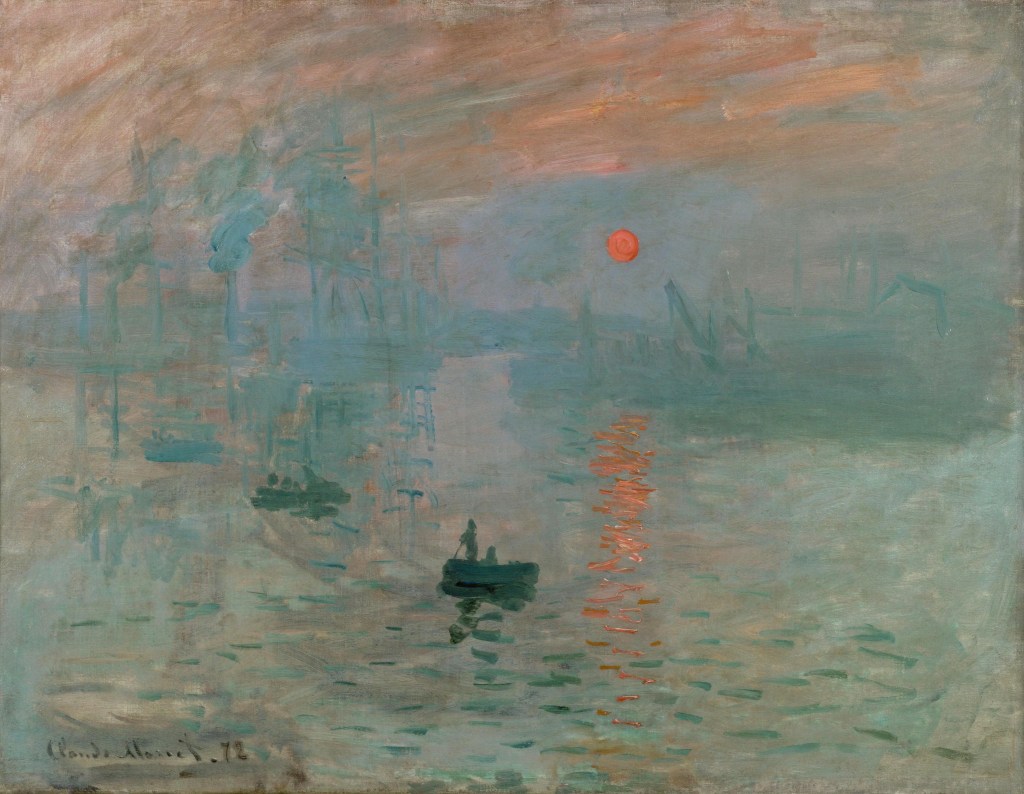
The term Impressionism originated in 1874, when these independent artists organized their own group exhibition at the studio of photographer Nadar, bypassing the Salon entirely. Among the paintings exhibited was a small seascape by Claude Monet titled Impression, soleil levant (Impression, Sunrise). The work depicted the harbor of Le Havre at sunrise, with misty silhouettes of boats and orange sunlight shimmering on the water.
Read more: Claude Monet and His Flowers
Unlike detailed, finished academic paintings, Monet’s canvas looked loose, sketchy, and spontaneous. He was not attempting to depict the scene with photographic precision. Instead, he aimed to convey the sensory impression it left on him—how it felt to see the light, the color, the atmosphere at that moment.
The title Impression was not meant to name a movement. It was merely a description of his approach. However, the painting caught the attention of Louis Leroy, an art critic who visited the exhibition. In a satirical review published in Le Charivari, Leroy mocked the painting and its title, writing that “wallpaper in its embryonic state is more finished than that seascape.”
Using Monet’s title to deride the entire group, Leroy sarcastically dubbed the artists “Impressionists”—a name meant to ridicule their perceived lack of skill and finish. But rather than rejecting the label, the artists embraced it. What was meant as an insult became a banner.
The Meaning of “Impression”
So, what does the word “impression” actually mean in this context?
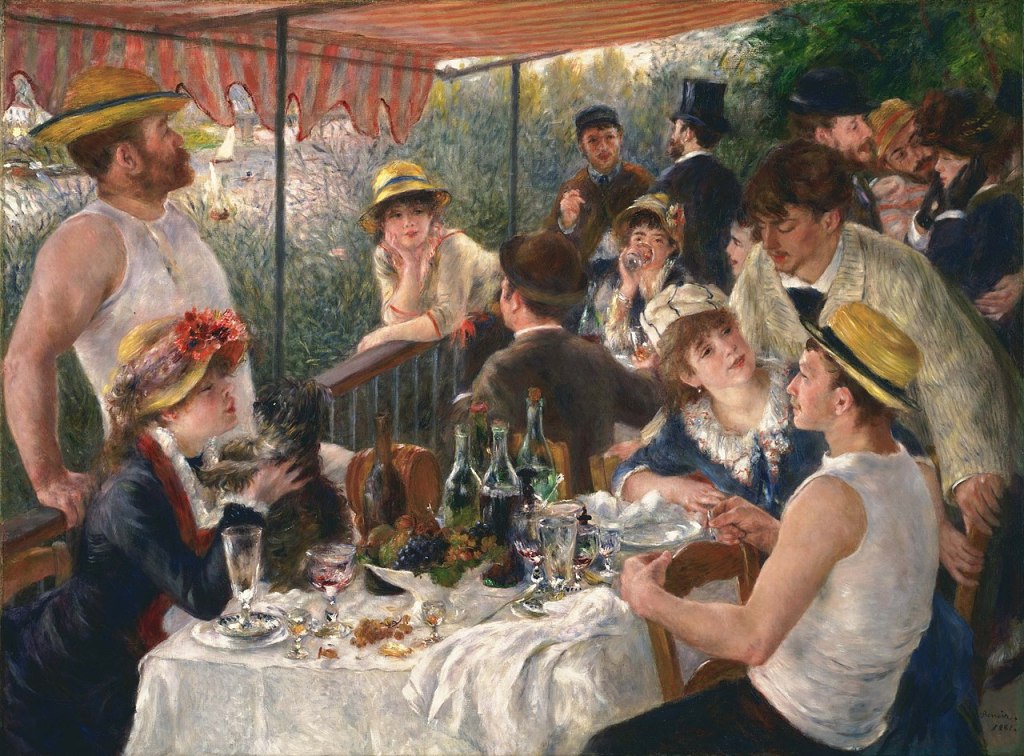
In everyday language, an impression refers to a fleeting, subjective experience, rather than a precise, detailed account. An impression is personal, sensory, and emotional. It reflects how light, atmosphere, and movement affect the observer in a specific moment, rather than what is “objectively” there.
This is exactly what the Impressionists were trying to capture. They abandoned the idea that art should imitate history or mythology or even replicate reality in exact detail. Instead, they painted life as it is perceived, focusing on:
- Changing light: using bright colors and visible brushstrokes to depict the shifting light of day.
- Atmosphere: capturing the mood or feeling of a scene rather than its static appearance.
- Everyday subjects: painting urban streets, cafés, trains, gardens, and people at leisure.
- Movement and spontaneity: portraying moments in flux, often outdoors (en plein air), with rapid execution.
By naming their movement Impressionism, they highlighted their goal to record impressions, not define absolutes. Their art was rooted in the here and now, grounded in experience rather than tradition.
The Scientific Influence
The name also aligns with broader intellectual trends of the time. In the 19th century, scientific discoveries in optics, light, and human perception were influencing how people understood vision. Scientists like Hermann von Helmholtz were studying how the eye perceives color and how light behaves in the natural world.
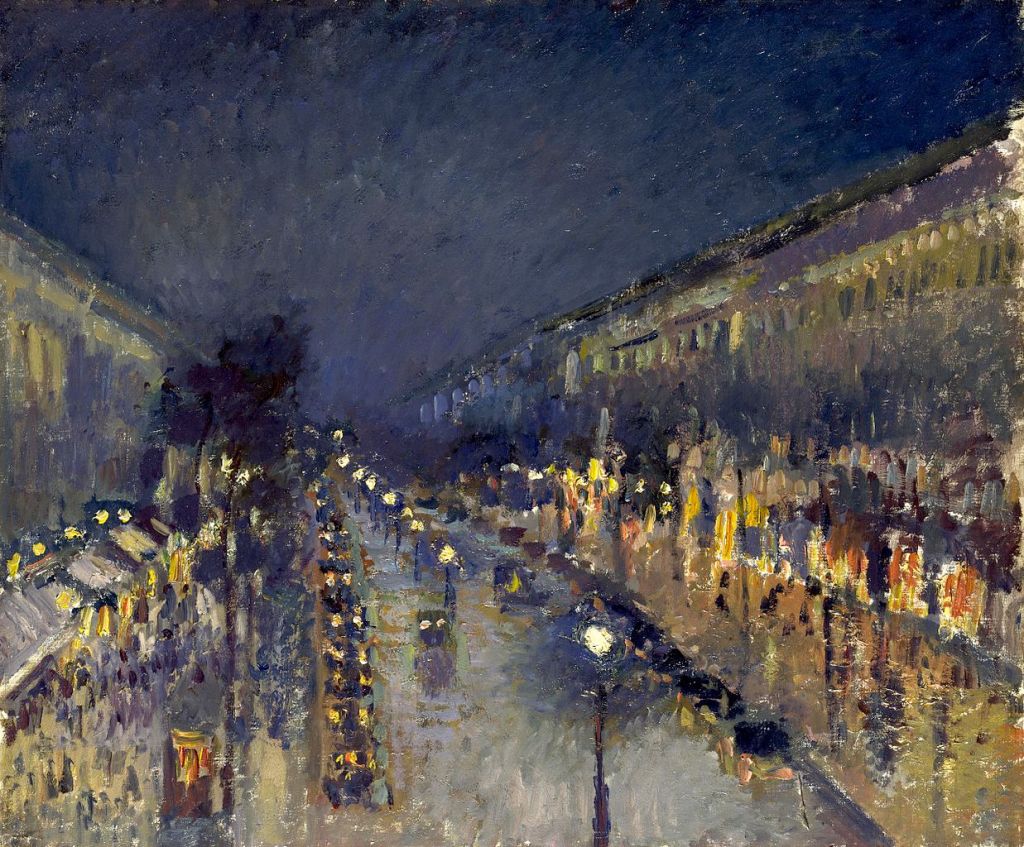
The Impressionists were keenly aware of these ideas. They experimented with complementary colors, broken color theory, and optical mixing, where small touches of different hues placed side by side would blend in the viewer’s eye. Their work was deeply informed by these scientific principles, even if their results looked “unfinished” by academic standards.
So, the term “impression” also suggests a psychological and perceptual emphasis, linking painting to how the mind perceives the world moment by moment, rather than how the world “truly” is.
It’s Still Impressionism
Though originally intended as mockery, the term Impressionism came to define one of the most beloved movements in art history. Over time, what critics saw as a lack of skill or discipline came to be seen as a radical liberation of vision. These artists broke free from centuries of rules and traditions to explore the immediacy of perception.
Thus, Impressionists laid the groundwork for modern art. Without Impressionism, we would not have Post-Impressionism, Expressionism, Fauvism, Cubism, or even Abstract art. The name became a starting point for a new artistic philosophy: art as an experience, not a product; as a process, not a performance.
 Artenquire