
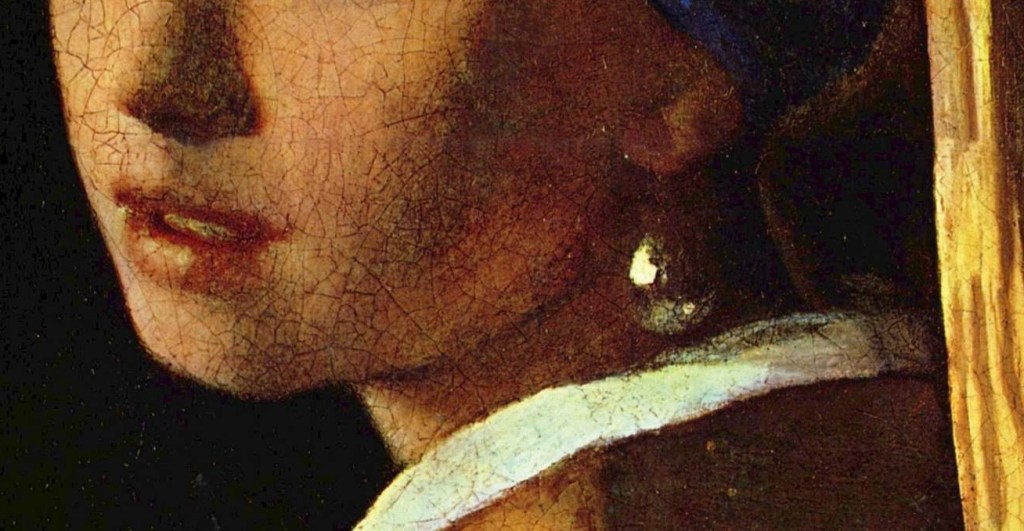
The young woman paused mid-movement. Her gaze instantly meets ours. Her lips are slightly open. The pearl on her ear shines with soft light. The painting seems simple, yet it creates an emotional response that continues across centuries.
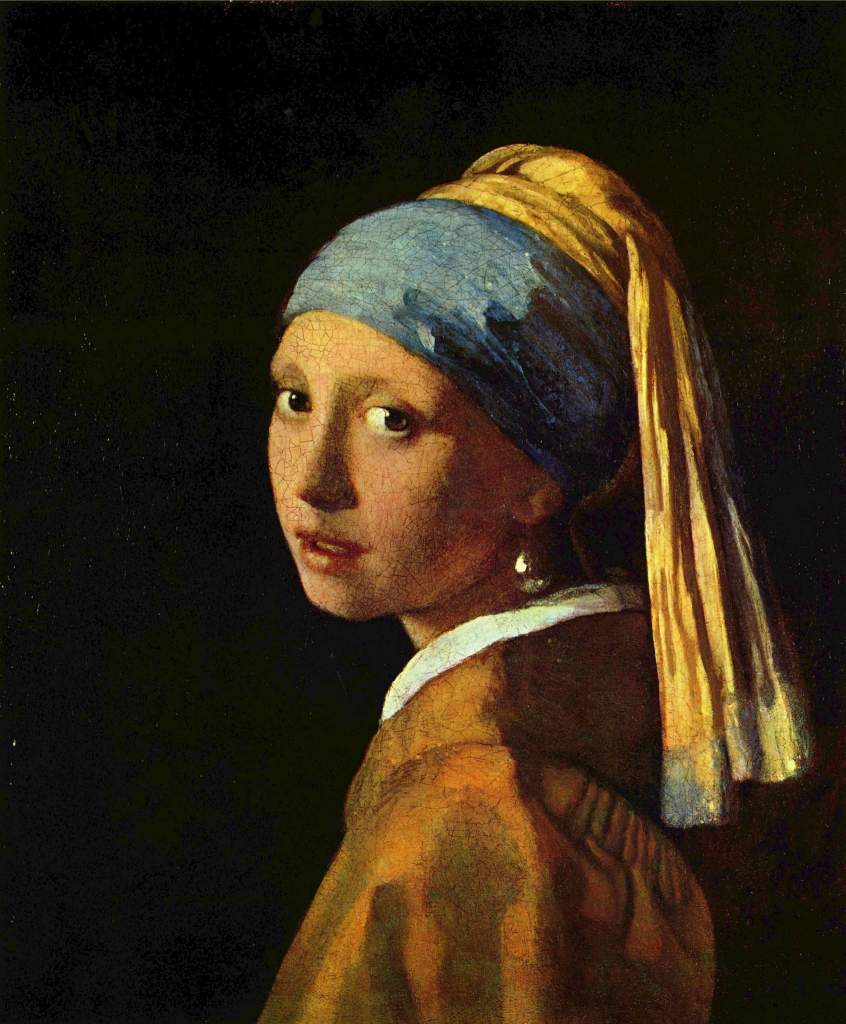
To understand Johannes Vermeer’s Girl with a Pearl Earring, let’s place it in its historical context and examine Vermeer’s personality, technique, and the ways scholars have interpreted the painting.
Vermeer and His Life in Delft
Johannes Vermeer was born in Delft in 1632 and lived there until he died in 1675. Delft was a quiet town known for its churches, canals, and craft traditions. It was also connected to trade routes that brought wealth into the Dutch Republic. Vermeer’s father was a tradesman who sold paintings and worked with textiles. He probably introduced his son to the world of art from an early age. Vermeer became a master painter in the Delft Guild of Saint Luke in 1653. He married Catharina Bolnes in the same year. They had many children and lived in the house of his mother-in-law, Maria Thins. This household shaped Vermeer’s daily life and may have influenced many of his interior scenes.

Very little is known about Vermeer’s training. No documents confirm who his teacher was. Some scholars think that Carel Fabritius, who worked in Delft for a short period, may have influenced him, although this idea remains unproven. What is known is that Vermeer developed a very personal style that stood out among Dutch painters of the time.
Vermeer did not produce many paintings. The surviving number is around 34. This small output may be due to his slow working method. He spent long periods on each canvas. His paintings show a high level of care and attention. They have a special sense of peace and a controlled use of light. During his life, his reputation was smaller than that of some other Dutch artists, although he was respected in Delft. After his death, his fame faded. He was rediscovered in the nineteenth century and became admired across the world.
The Dutch Golden Age
Vermeer lived during the Dutch Golden Age, which lasted through much of the seventeenth century. At that time, the Netherlands was a center of global trade. Goods from Asia, Africa, and the Americas arrived in ports such as Amsterdam. People were aware of distant cultures. Exotic clothing and objects became sources of imagination. At the same time, Dutch values stressed modesty, careful behavior, and interest in household life. Paintings often balanced these influences. They showed daily life with realistic detail, but they sometimes added elements of fantasy.
Dutch art of this period focused on daily life, landscapes, still lifes, portraits, and scenes of work. Painters showed houses, kitchens, music rooms, markets, and quiet streets. Their images reflected the values of society. These values included modesty, discipline, appreciation of household life, and interest in the natural world. Vermeer belonged to this world, but his work has a unique atmosphere. He did not paint busy markets or large historical scenes. He explored quiet rooms, soft light, and moments of stillness.
The cultural environment also shaped attitudes toward women in art. Many paintings showed women at work, reading letters, playing musical instruments, or engaged in household tasks. They appeared in peaceful settings. Vermeer followed this interest, yet he gave his female figures special dignity. They appear thoughtful and self-possessed. The girl in Girl with a Pearl Earring carries this dignity even though she does not perform a task. Her presence is enough.
Vermeer’s Technique
Art historians have studied Vermeer’s technique with great interest. His paintings display a special balance between precision and softness. He used fine layers of paint that created smooth transitions between tones. His light appears natural and calm. Many researchers have examined his pigments. One of the most striking features is his use of ultramarine. This pigment was made from lapis lazuli, a stone that came from distant regions. It was expensive. Vermeer used ultramarine generously in shadows, drapery, and clothing. His choice suggests that he valued rich color and invested in high-quality materials.
Some scholars think that Vermeer may have used a camera obscura. This device is based on optical projection. A scene outside enters a darkened room through a small opening or a lens. The image appears on a surface inside the room. The device was known in the seventeenth century. It could have helped painters study light effects. The soft sparkle of highlights in Vermeer’s work has been compared to what one sees through a camera obscura. Yet there is no proof that Vermeer depended on such a tool. Many painters of the period studied light by observation alone. The idea remains debated.

Vermeer’s compositions are carefully constructed. Objects appear in simple arrangements. Lines lead the eye toward the main figure. Light enters through a window that cannot always be seen. Shadows fall in subtle ways. These choices create a mood of calm concentration. They also give the viewer a sense that the scene is part of an intimate world.
Girl with a Pearl Earring belongs to a type of painting called a tronie. A tronie is an image of a head or a figure in interesting clothing. It is not meant to represent a specific person who paid for the portrait. Tronies allowed artists to experiment with expressions, costumes, and lighting. Many Dutch artists created tronies to explore character types. These types could include a soldier, a scholar, a young woman, or a stranger in exotic garments.
The girl in Vermeer’s painting wears a turban that suggests foreign fashion. Her earring is oversized and luminous. Her clothing does not identify her as a person from Delft. Instead, she represents a figure of beauty, freshness, and youth that seems to belong to a world of imagination. Her identity has never been confirmed. There is no record of her name or family. There is no evidence that she posed for a paid commission. She appears to be a model used for artistic exploration rather than a documented individual.
This idea affects how viewers perceive the painting. Because she is not tied to a known story, she becomes a universal figure. Anyone can imagine a narrative around her. She appears suspended in a moment that feels both real and timeless. This sense of openness helps explain the lasting appeal of the painting.
Now, let’s focus on the painting’s visual qualities. The background of the painting is dark and plain. This setting directs attention toward the girl’s face. Her skin has a soft glow. The light falls gently across her cheek and forehead. Her lips have a slight sheen. Her eyes look toward us with a calm and steady expression. Her head turns as if she has just responded to a voice or a movement. Her mouth is slightly open, giving the impression that she is about to speak. The small glimmer on the pearl earring strengthens the sense of life. The viewer feels invited into the moment.
The girl’s attire has been examined by many scholars. The turban consists of blue, gold, and white cloth. The folds appear crisp and simple. The pigments used for the blue part include ultramarine. The bright tone of ultramarine adds to the gentle contrast between her skin and the fabric. Her jacket has soft yellow tones created with lead-tin yellow. The painting shows fine harmony of color, light, and form.
Because the scene is so simple, it creates a strong emotional effect. There are no objects around her: no furniture or interior space. The image rests entirely on the power of the face and the pearl. This careful reduction creates a sense of closeness. The viewer meets the girl without distraction.
Interpretations of the Painting
There are many interpretations of Girl with a Pearl Earring. Scholars, critics, and ordinary viewers have proposed different ideas about the expression of the girl and the meaning of the pearl.
The expression. Her gaze is direct. Her lips are parted. She seems aware of the viewer. Some people see innocence. Others see quiet confidence. Others feel that she holds a secret. Vermeer did not describe her feelings in a clear narrative. This gives the painting a sense of openness. It invites viewers to read emotion into her expression based on their own experience.
The pearl. Pearls appeared often in Dutch art of the seventeenth century. In some paintings, they were symbols of purity. In others, they represented wealth and social status. They also offered a chance for painters to show their skill with reflections. The pearl in Vermeer’s painting is large and bright. It may have been an artistic device rather than a real pearl. Some scholars believe that a simple glass drop could have served as the model. Regardless of its material, the pearl gives the picture a sense of elegance. It marks the girl as someone special within the imagined world of the painting.
The exotic clothing. The turban resembles styles that appear in other tronies of the period. European artists enjoyed using garments from the East or the Mediterranean because they added a sense of mystery. These clothes did not reflect local fashion. They created the impression that the figure came from a distant place or from a different cultural world. In Vermeer’s painting, the turban heightens the sense of charm and novelty.
The psychology. The girl appears at once present and distant. She engages the viewer with her gaze, yet she remains silent and unknown. The lack of contextual detail strengthens this dual effect. Many writers have described her as a figure who represents beauty in a pure sense. She does not tell a story. She simply exists in a moment of attention. This is why the painting is often compared to poetry. It offers emotion without a full narrative.
The Story Behind…?
There are no confirmed stories behind Girl with a Pearl Earring. Vermeer left no letters or notes about the model or the circumstances of the painting. There is no record of a commission. No document names the girl. The painting appears to have been created as a tronie and not as a portrait of a known person. For this reason, the true background of the work remains unknown.
The absence of information encouraged later writers and filmmakers to imagine their own narratives. The most famous example is the novel Girl with a Pearl Earring by Tracy Chevalier, published in 1999. The novel presents a fictional servant named Griet who becomes involved in Vermeer’s household. It also suggests emotional tension between her and the painter. In 2003, the novel became a film with the same title. The movie follows the story invented in the book and adds its own atmosphere. Both the novel and the film are works of fiction. They do not reflect historical events. They simply show how strongly the painting inspires modern imagination.
Some other ideas also appear in popular culture. One idea is that Vermeer may have fallen in love with the model. Another is that the model was one of his daughters. These ideas are unproven. No evidence connects the painting to any member of his family. There is also no proof that he used a servant or that a young woman from Delft left any record as the model. The painting may represent a real person, but it may also be a combination of observation and artistic invention.
The suggestion that the pearl was a simple glass drop is another example of modern speculation. Scholars point to its size and brightness, yet this remains uncertain. No document describes the object used by Vermeer. The painting gives very little information about its materials except what can be seen on the surface.
The absence of a confirmed story became part of the painting’s power. The girl appears close to the viewer yet remains silent and unknown. This sense of mystery has inspired fiction, but the historical truth stays simple. Vermeer created an expressive figure and left no explanation. The result is an image that invites each generation to imagine, even though nothing beyond the painting itself is proven.
The Rediscovery of Vermeer
After Vermeer died in 1675, he left debts and a large family. His work was appreciated by some collectors but did not remain widely known. In the eighteenth and early nineteenth centuries, many of his paintings were attributed to other artists. Scholars did not yet understand his importance. As interest in Dutch art grew in the nineteenth century, experts reexamined many paintings. They compared signatures, styles, and pigments. They recognized Vermeer’s unique hand. His fame rose. Museums acquired his works and displayed them to wider audiences.
Girl with a Pearl Earring gained special attention in the twentieth century. Exhibitions in major museums attracted large crowds. Reproductions appeared in books and articles. The image became familiar around the world. People admired the sense of intimacy and the fresh feeling of the painting. Its restoration in the late twentieth century improved its condition and revealed more of its original beauty.
The painting has inspired novels, films, and many cultural responses. These works often present fictional stories that should not be confused with historical facts. They show how strong the painting’s impact is on the modern imagination. Yet the power of the image does not depend on any invented narrative. It comes from the painting itself.
 Artenquire